
Wild for Salmon
When we first started carrying seafood, it became immediately apparent that there’s a lot more to it than just putting fish in a freezer and calling it good.
We wanted a brand that fit our mission of providing “inspired, real food.” In terms of salmon, this meant finding a vendor that specialized in fresh, wild-caught fish.
The Problem with Farmed Salmon
For most grocery stores, the default option is farmed Atlantic salmon. These fish are typically raised in crowded net pens and fed synthesized pigments to replicate wild salmon’s natural coloring. More than that, farmed salmon has been associated with higher levels of contaminants compared to wild varieties. The “fresh salmon" at your average supermarket is almost certainly farmed. And it's often mislabeled on top of it.
Wild Pacific salmon — sockeye, coho, king — is a different product entirely. Higher in omega-3s, lower in contaminants, and no synthetic anything. And seeing "wild-caught" on a label doesn't automatically mean you're getting that. It means you need to know your source.
From the Boat. Not from a Distributor.
Steve and Jenn Kurian started Wild for Salmon in 2004 with a simple goal: bring wild Alaskan sockeye back to their community in Pennsylvania. What began as sharing a freezer full of fish with neighbors has grown into a coast-to-coast operation. But their transparency and sourcing hasn't changed a bit. Wild for Salmon is fisherman-owned and operated. Steve is the one on the boat in Bristol Bay, Alaska each season. He's also, more often than not, the one cutting your portions and fillets back at their facility in Bloomsburg, Pennsylvania.
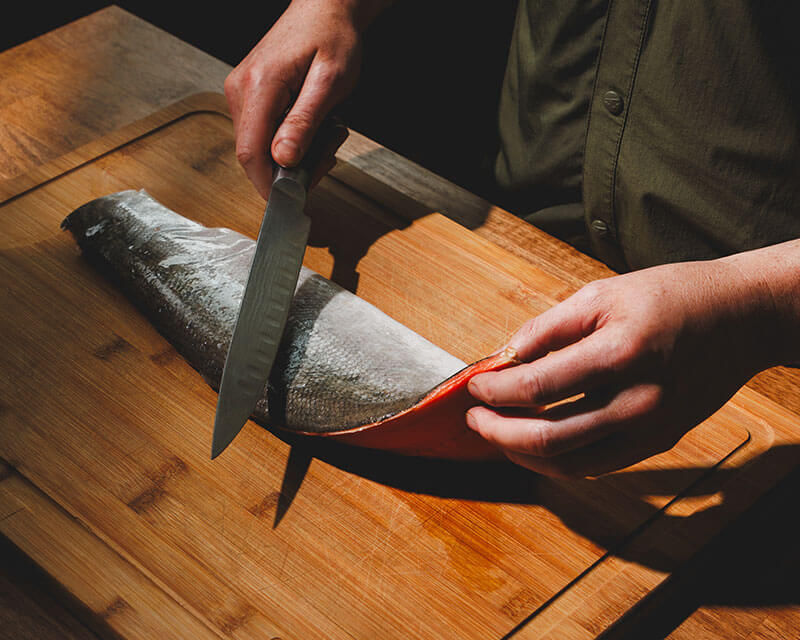
In an industry where fish can change hands four or five times before reaching a consumer, this shortened journey from sea to shelf matters. The ability to track exactly where our food comes from is central to th Simply Fresh Market philosophy. Wild for Salmon makes it exceptionally easy: The salmon is packed up on the boat in Alaska, shipped to Pennsylvania where it’s prepped and packaged, and sent right here to our store in Brighton, Michigan.
What does it mean to be “Wild-Caught”?

The wild-caught label is everywhere. It's on menus, on grocery store freezer bags, on the kind of salmon that's been sitting under fluorescent lights for who knows how long. “Wild-caught" has become one of those phrases that sounds reassuring until you start asking questions: Where was it caught? By whom? How many places does it go before ending up on your plate?
Those are the right questions to ask. And they're exactly why we carry Wild for Salmon.
Wild for Salmon is also dedicated to sustainability. Bristol Bay is the largest wild sockeye salmon run in the world. As such, the Wild for Salmon team strives to provide not only the best quality fish, but to preserve both the fishing industry and environment.
“When you choose Wild for Salmon Seafood, you’re backing real fishermen, clean glacial waters, and generations of careful stewardship." - Wild for Salmon
From our shelves to our kitchen
Our smoked salmon dip and salmon patties — both original Simply Fresh recipes — are made with their salmon. Not a generic seafood supplier. Not whatever was available. This specific fish, from this specific source.
That's not a small thing. When we build a house recipe around an ingredient, we’re committing to it. It means we trust it completely— the quality, the consistency, the sourcing. Wild for Salmon is the standard our kitchen holds itself to. If you've tried the dip or the patties and thought that's really good fish, now you know why.
From top, clockwise: A filet of sockeye salmon, our Salmon Patties, and our Smoked Salmon Dip.
Real Seafood, Transparently Sourced
At Simply Fresh, knowing where your food comes from isn't a tagline. It's the whole point of what we do. With Wild for Salmon, that answer is unusually specific: Bristol Bay, Alaska, on a vessel called the F/V Ava Jane, captained by the same people who founded the company.


Comments